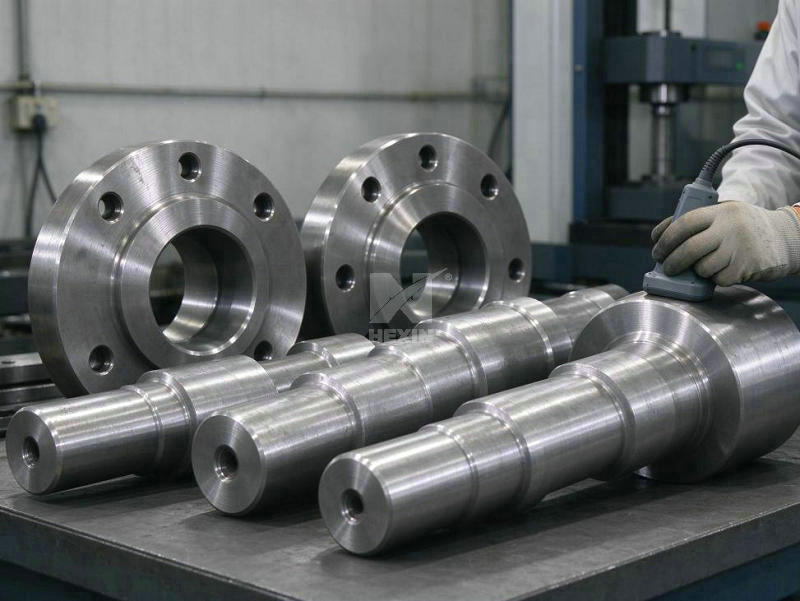
Core advantages of forging process: why forgings are preferred for key components
When selecting mechanical components, many clients ask: why must forgings be used for critical load-bearing parts, even when the raw material grade is the same? The answer lies in the unique ability of the forging process to modify the internal microstructure of the metal.
First, it eliminates inherent internal defects, resulting in a denser microstructure. After steel ingots are cast, they inevitably contain defects such as porosity, gas pockets, and non-metallic inclusions. During forging, the application of immense triaxial compressive stress compacts and welds these internal voids, significantly increasing the material's density. This mitigates the risk of sudden component failure under high-pressure, impact, or cyclic loading conditions—an outcome that is difficult to achieve through casting.
Second, it refines the grain structure, simultaneously enhancing overall mechanical properties. The plastic deformation induced by forging, combined with dynamic recrystallization, breaks down coarse as-cast grains. This grain-refinement strengthening improves tensile strength, yield strength, and impact toughness. Under long-term cyclic loading, high-quality forgings exhibit a fatigue life far superior to that of castings made from the same material, making them ideal for critical components subject to repetitive stress where sudden fracture is unacceptable.
Third, it allows for the controlled orientation of metal "flow lines" (grain flow). These flow lines—analogous to the grain in wood—align with the component's contours, providing optimal load-bearing capacity when the stress is applied along the direction of the flow. At Qingdao Hexin Machinery Co., Ltd., we utilize CAE metal-flow simulation software during the process design phase. This allows us to predict metal flow patterns and strategically direct the grain flow to avoid areas of stress concentration, thereby maximizing the material's inherent performance. In contrast, machining a component directly from a raw blank often severs these flow lines, severely compromising the part's load-bearing capacity.
Fourth, it offers flexible process routes, enabling production solutions tailored to specific requirements. From large-scale, free-forged blanks weighing tens of tons to small, precision closed-die forgings weighing only a few kilograms, we offer flexible solutions—including hot, warm, and cold forging—tailored to each client’s specific order volume, budget, and precision requirements. We also integrate heat treatment processes such as quenching and tempering, normalizing, annealing, and tempering to precisely control the hardness and toughness of the finished parts, ensuring compliance with both domestic and international industry standards (e.g., GB, ASTM, EN) as well as specific client technical agreements.
Fifth, we have established a comprehensive, closed-loop quality inspection system. Producing a qualified forging requires rigorous inspection and control throughout the entire manufacturing process. Qingdao Hexin Machinery Co., Ltd. operates an independent testing laboratory; before leaving the factory, all forgings undergo a full suite of evaluations, including spectral analysis of raw materials, mechanical tensile and impact testing, non-destructive testing (such as ultrasonic testing [UT] and magnetic particle testing [MT]), and complete dimensional verification. For every batch, we provide material certification and a full set of inspection reports, ensuring complete traceability of product quality.
Leveraging comprehensive forging production lines, heat treatment facilities, and testing equipment, Qingdao Hexin Machinery Co., Ltd. supports clients throughout the entire process—from early-stage product structure optimization, process simulation, and mold development to prototyping and stable, large-scale production. We provide compliant, highly reliable forging solutions tailored to the needs of customers across a wide range of industries.