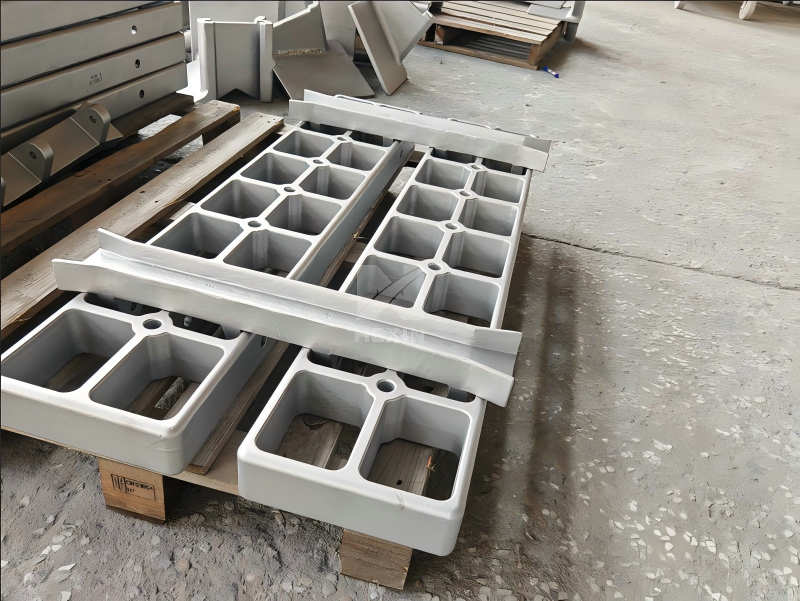
Advantages of 1.4849 Heat-Resistant Steel Fixture
1.4849 is a 38Ni-19Cr-Nb high-nickel niobium stabilized austenitic heat-resistant cast steel (GX40NiCrSiNb38-19), while 1.4848 is a 25Cr-20Ni (GX40CrNiSi25-20, i.e., HK40/2520 cast steel). When used for heat treatment fixture (material baskets, trays, lifting tools, clamps), 1.4849 exhibits significantly better resistance to carburizing/nitriding, high-temperature creep strength, and long-term service stability than 1.4848, typically resulting in a longer service life. However, in pure air high-temperature furnaces, its oxidation resistance is actually inferior to 1.4848, and it is more expensive. Ultimately, which is more cost-effective depends on your furnace atmosphere and temperature.
I. Core Advantages of 1.4849 Compared to 1.4848
1. Superior Resistance to Carburizing/Nitriding (Greatest Advantage): Nickel does not form stable carbides, and high nickel content (36-39%) significantly reduces the solubility and diffusion rate of carbon in austenite. In carburizing and carbonitriding furnaces, 1.4848 feed frames are prone to surface carburization, grain boundary embrittlement, volume expansion, and even cracking after long-term use; 1.4849 has a much shallower carburized layer, which can withstand strong carburizing/nitriding atmospheres, significantly extending fixture life. This is the core reason why it is recommended to replace 25Cr-20Ni materials in carburizing and carbonitriding fixtures.
2. Long-Term Service Stability Due to Niobium Stabilization: Nb (1.2-1.8%) forms stable NbC pinning grain boundaries, inhibiting continuous grain boundary carbide and σ phase precipitation at long-term high temperatures. The results show higher high-temperature creep/endurance strength (see above figure), and better ductility retention and resistance to brittle fracture after long-term service. 1.4848 tends to become brittle after hundreds or thousands of hours in the furnace, with cracks initiating at grain boundaries; 1.4849 exhibits significantly better resistance to creep embrittlement and thermal fatigue cracking.
3. Resistance to Thermal Fatigue/Rapid Heating: High-nickel austenitic material exhibits good high-temperature ductility. Under repeated furnace loading and unloading, and oil-quenching/water-quenching cycles, it demonstrates strong thermal stress release capabilities and is less prone to hot cracking—a crucial indicator for heat treatment fixture.
4. Overall Service Life and Economy: Industry/supplier data indicates that under heavy load or carburizing conditions at 900-1050°C, the fixture life of 1.4849 is typically 1.5-3 times that of 1.4848. Although the unit purchase price is higher (nickel price accounts for the majority, generally 30%-60%+ more expensive), the overall cost is often lower when spread across each ton of workpiece and each furnace cycle, plus the reduction in downtime for basket replacement. This is the main reason why 1.4849 is used for large multi-layer racks and custom-made racks.
II. Disadvantages and Applicable Boundaries of 1.4849 (Objective Explanation)
· Inferior oxidation resistance compared to 1.4848: 1.4849 contains only 18-21% chromium (compared to 24-27% for 1.4848), and the standard specifies an upper limit of approximately 1020°C for oxidation resistance in clean air, lower than the approximately 1050°C for 1.4848. If the fixture is used in a pure air furnace for extended periods at temperatures >1000°C, with oxidation and burn-off as the primary failure mode, 1.4848 is actually more durable and cheaper.
• High cost and slightly more difficult casting/welding: High-nickel cast steel has a slightly higher tendency for hot cracking and segregation, requiring higher standards for casting processes and welding materials, and resulting in higher repair and welding costs.
• Temperature resistance limit is not infinitely high: For heavy loads exceeding 1050°C or stronger resistance to carburization, a higher grade of 1.4852 (GX40NiCrSiNb35-26, HP-Nb type) or nickel-based alloys should be selected; 1.4849 is not the endpoint.