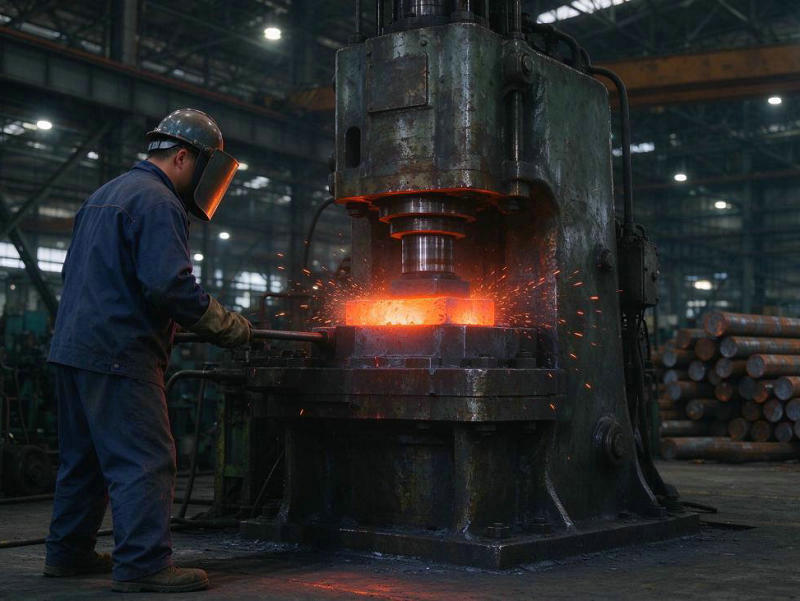
What is forging? Through countless hammering and refining, it creates the core components of high-end equipment.
Forging is a metal plastic forming process that has a history of thousands of years and continues to embrace digital upgrades. Unlike casting where metal is melted and poured into molds to form, forging takes place when the metal remains in a solid state. Using equipment such as forging hammers, hydraulic presses, and ring rolling machines, controlled pressure is applied to the metal billet, causing stable plastic deformation. This process not only shapes the desired form but also fundamentally optimizes the internal structure of the metal.
In simple terms, forging is not just about shaping the external form of a part; it is a "reshaping and strengthening" of the metal itself. Through repeated hammering and extrusion, the original casting defects such as pores, porosity, and shrinkage cavities remaining in the metal during the smelting stage are compacted and welded together. The coarse cast grains are broken and refined during the deformation and recrystallization process, ultimately forming continuous metal fiber streams that conform to the contour of the part. This unique microstructure characteristic gives forged parts far superior strength, impact toughness, and fatigue resistance compared to cast parts and directly machined parts. This is the fundamental reason why various heavy-load equipment key components prefer to use forged parts.
The forging workshop in the hot forging area
According to the molding method, forging is mainly divided into three categories: free forging, die forging, and ring rolling:
l Free forging: Using simple fixtures and tools to apply pressure, the cost of the mold is low, the process is flexible, and it is suitable for single-piece and small-batch production of large shafts, cylinders, heavy blank parts;
l Die forging: The metal is formed in a closed mold cavity in one step, with higher dimensional accuracy and better material utilization, suitable for large-scale components with relatively complex structures;
l Ring rolling: Also known as ring rolling, it is specifically used for rolling ring-shaped rotating parts, widely producing flanges, gear rings, bearing rings, rotating support rings, etc.
According to the forging temperature, it is divided into hot forging, warm forging, and cold forging. Among them, hot forging has the widest application range. By preheating to reduce the metal's deformation resistance, it is suitable for most materials such as carbon steel, alloy steel, stainless steel, and special alloys; cold forging is formed at room temperature, with high product accuracy and excellent surface quality, and is mostly used for small and precise load-bearing parts; warm forging is between the two, balancing the difficulty of forming and dimensional accuracy, and is a popular process route in the field of precision forging in recent years.
Forgings, as the basic core blanks for equipment manufacturing, are applied in numerous high-end fields such as construction machinery, wind power and new energy, petrochemicals, automobiles, rail transit, mining equipment, aerospace, etc. Key components that long-term bear impact, alternating loads, such as crankshafts, connecting rods, gears, flanges, main shafts, high-pressure valve bodies, and lifting hooks, can only be ensured to operate stably and safely for a long time if they are made of qualified forgings.
In the current continuous upgrade of high-end manufacturing, lightweighting, high reliability, and extremely long service life have become the basic needs of the entire industry. The forging technology is also continuously evolving towards precision near-net shape forming, CAE digital simulation, intelligent heat treatment, and green low-consumption directions. Qingdao Hexin Machinery Co., Ltd. has been deeply engaged in the forging field for many years, possessing mature production capabilities for free forging, die forging, and ring rolling parts, and can provide one-stop services including heat treatment, precision machining, and non-destructive testing, supporting customers to customize according to drawings and samples, providing stable and reliable forging component solutions for downstream equipment manufacturers. Welcome all customers to consult and negotiate.